
Dr. Hamilton on the Good Neighbor Podcast, listen here!
June 1, 2026
Tips For Walking Your Dog During a Florida Summer
August 10, 2026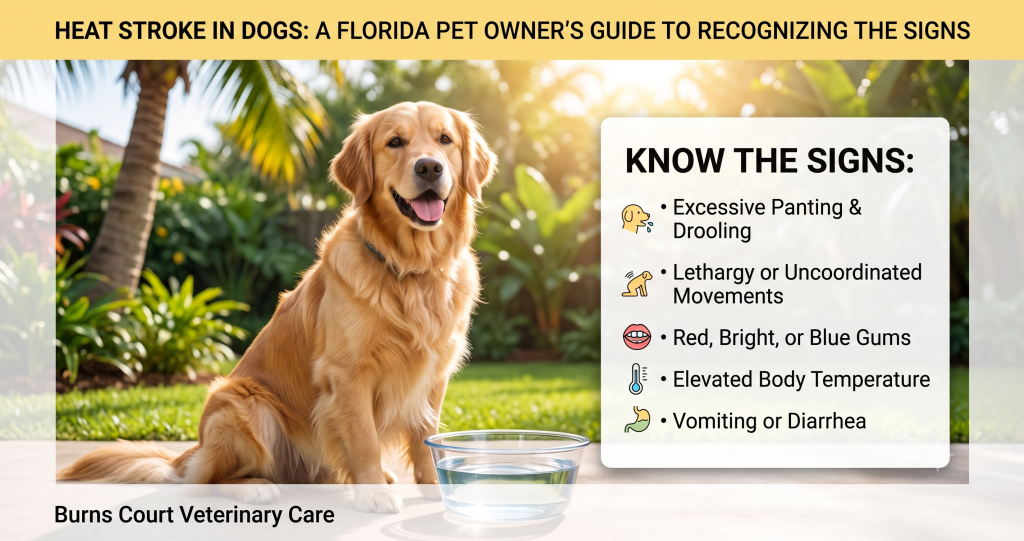
Heat Stroke in Dogs: A Florida Pet Owner’s Guide to Recognizing the Signs
Living on Florida’s Gulf Coast has plenty of perks, but our long, hot, and humid summers can pose serious health risks for our canine companions. Every summer, veterinarians throughout Florida treat dogs suffering from heat exhaustion and heat stroke—conditions that can become life-threatening in a matter of minutes.
At Burns Court Veterinary Care, we are especially concerned about our brachycephalic (short-nosed) patients, such as French Bulldogs, English Bulldogs, Pugs, Boston Terriers, Shih Tzus, and Boxers. These breeds have a much more difficult time cooling themselves through panting and are at significantly higher risk for overheating.
Fortunately, knowing the warning signs and acting quickly can save your dog’s life.
Why Is Heat Stroke So Common in Florida?
Unlike people, dogs cannot cool themselves by sweating. Instead, they rely almost entirely on panting to regulate their body temperature.
Florida’s combination of high temperatures and high humidity makes this much more difficult. Humid air limits the evaporation that occurs during panting, meaning your dog’s natural cooling system becomes much less effective—even during a relatively short walk.
This is why we sometimes see heat stroke in dogs on mornings that don’t feel especially hot to us.
Which Dogs Are Most at Risk?
Yes, the brachycephalic breeds are at higher risk, but they aren’t the only ones. Any dog can develop heat stroke, and certain pets are much more susceptible, including:
● Brachycephalic (flat-faced or smush-faced) breeds
● Overweight or obese dogs
● Senior dogs
● Puppies
● Dogs with heart disease or respiratory disease
● Any dog exercising vigorously in very hot and/or humid weather
Early Signs of Overheating
Heat stress often begins gradually before progressing to heat stroke.
Watch for:
● Excessive or unusually heavy panting
● Thick or excessive drooling
● Bright red gums or tongue
● Restlessness and/or anxiety
● Seeking shade
● Slowing down during walks, reluctance to move, and/or refusing to continue walking
This is your dog’s way of saying, “I’m getting too hot.”
Signs of Heat Stroke
As body temperature continues to rise, heat stroke can quickly affect the brain, kidneys, liver, gastrointestinal tract, and blood clotting system.
Seek emergency veterinary care immediately if you notice:
● Collapse
● Difficulty breathing
● Vomiting or diarrhea (especially if bloody)
● Confusion or disorientation
● Stumbling or inability to stand or walk normally
● Pale, gray, or blue gums
● Muscle tremors
● Seizures
● Loss of consciousness
Heat stroke is a true medical emergency. Even if your dog appears to recover after cooling off,
internal organ damage may continue to develop.
What Should You Do?
If you suspect your dog is overheating:
1. Move them immediately into an air-conditioned or shaded area.
2. Offer cool (not ice-cold) water if they are alert and able to drink.
3. Wet their body with cool water, paying particular attention to the belly, groin, feet, and armpits.
4. Place them in front of a fan if available.
5. Head to your veterinarian or the nearest emergency hospital immediately while continuing gentle cooling.
Avoid ice baths or covering your dog with ice, as cooling too rapidly can actually interfere with
normal heat loss.
Why Flat-Faced Dogs Need Extra Protection
Dogs with shortened muzzles simply cannot move enough air to cool themselves efficiently.
For many brachycephalic breeds, a walk that seems perfectly comfortable to you can quickly become dangerous—especially during a humid Sarasota summer.
If you own a French Bulldog, English Bulldog, Pug, Boston Terrier, or Shih Tzu, it’s often safest to reserve outdoor activity for the coolest parts of the day.
Prevention Is Always Better Than Treatment
The good news is that most cases of heat stroke are preventable.
● Never leave your dog in a parked vehicle.
● Provide access to shade and fresh water anytime your dog is outdoors.
● Avoid strenuous exercise during Florida’s hottest and most humid hours.
● Know your dog’s individual risk factors.
● Stop activity immediately if your dog begins showing early signs of overheating.
If you’re ever unsure whether your dog is too hot, err on the side of caution. Missing one walk is
far safer than risking a life-threatening emergency.
References
- Cornell University College of Veterinary Medicine. Heatstroke: A Medical Emergency.
Available at:
https://www.vet.cornell.edu/departments-centers-and-institutes/riney-canine-health-cente
r/canine-health-information/heatstroke-medical-emergency - Cornell University College of Veterinary Medicine. Summer Heat Safety Tips for Dogs.
Available at:
https://www.vet.cornell.edu/departments-centers-and-institutes/riney-canine-health-cente
r/canine-health-topics/summer-heat-safety-tips-dogs - American Kennel Club. Heatstroke in Dogs: Signs, Symptoms & Treatments. Available
at: https://www.akc.org/expert-advice/health/heatstroke-in-dogs/ - PetMD. Heatstroke in Dogs: Signs, Treatment, and Prevention. Updated December 17,
- Available at: https://www.petmd.com/dog/conditions/systemic/heatstroke-dogs